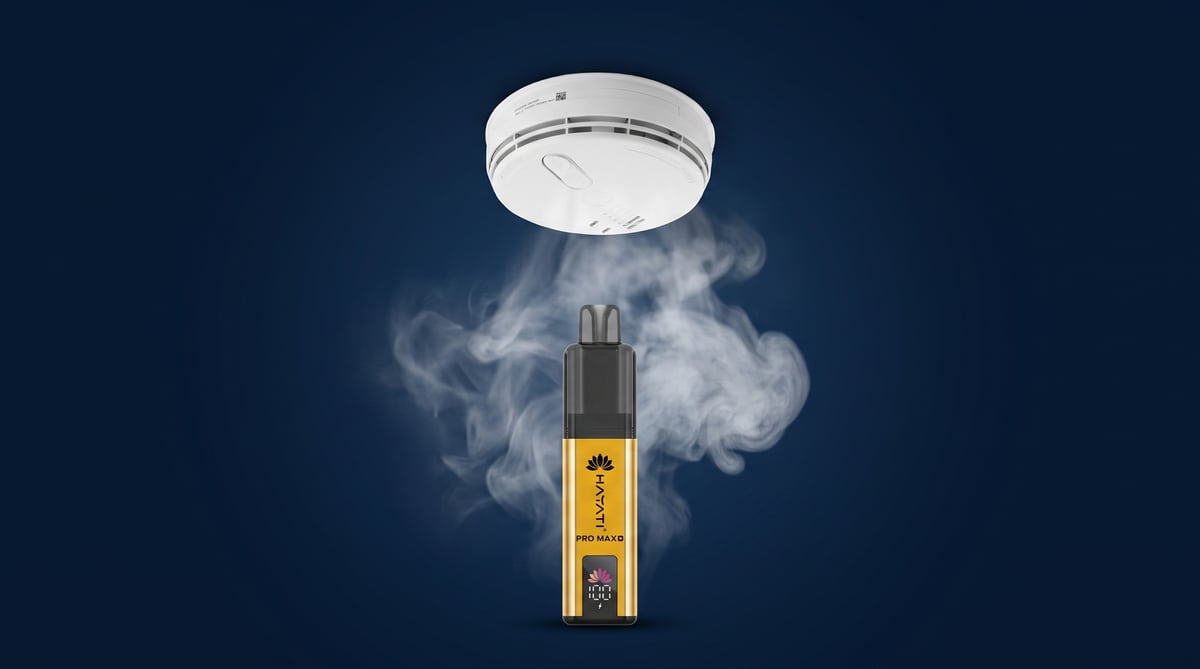
Does Vaping Set Off Smoke Alarms?

Whether your vape trips the alarm comes down to sensor type, cloud density and distance. Optical sensors can mistake a dense high-VG cloud for smoke, while ionisation and heat alarms rarely react. This guide breaks down which alarms you need to worry about and exactly how to vape indoors without setting one off.
Short Answer: Do Vapes Set Off Smoke Alarms?
Yes, vapes can set off smoke alarms, but it depends on the type of alarm and how you vape. The vapour you exhale is an aerosol of tiny liquid droplets, not combustion smoke, so it does not carry the burnt carbon particles a fire produces. That said, a dense cloud can still scatter light inside a detector's chamber or drift into the sensor and trigger it.
The single biggest factor is the sensor sitting above your head:
- Ionisation alarms respond to combustion particles from actual fire. They rarely react to vapour.
- Optical (photoelectric) alarms detect particles that scatter a beam of light. Vapour droplets do exactly that, so these are far more likely to trigger.
Most modern UK homes and nearly all hotels use optical or combination alarms, which is why so many people get caught out.
When it's likely vs unlikely
Risk of setting off a smoke alarm with a vape increases with proximity, cloud density and the liquid you are running. Big vape clouds off a high-VG shortfill sitting right under an optical alarm are the classic trigger. A small MTL puff of a 50/50 nic salt across the room from an ionisation alarm almost never is.
Likely to trigger
- Optical or combination alarm
- Vaping within a metre or two of the sensor
- High-VG liquid (70/30 or thicker)
- Sub-ohm device at higher power, dense clouds
- Poor ventilation, still air
Unlikely to trigger
- Ionisation alarm
- Vaping several metres away, another room
- 50/50 or higher-PG salt liquid
- Low-power MTL pod, thin vapour
- Good airflow, an open window
Vapour vs smoke
Smoke is the product of combustion, solid carbon and ash particles that hang in the air. Vapour is condensed liquid that evaporates quickly, which is why the cloud you exhale disperses in seconds rather than lingering like it would from a fire.
Optical smoke alarms cannot tell the difference between smoke and any particle that scatters the light, so an optical sensor treats a thick VG cloud as a threat even though nothing is burning.
Understanding the alarm type is the main takeaway here. For where vaping stands in law and how the rules are set, see our UK Vaping Laws, Safety & Compliance hub.
How Smoke Alarms Actually Detect Vapour
Whether your vape sets off an alarm comes down to one thing: the type of sensor sitting in that plastic disc on your ceiling. Not all alarms work the same way, and the difference decides whether your vapour cloud gets ignored or triggers a false alarm.
The core mechanism is particle size. Smoke from combustion produces tiny, dry soot particles. Vapour is made of much larger liquid droplets of vegetable glycerine and propylene glycol suspended in air. Those droplets are a completely different size and composition to smoke, which is exactly why some sensors shrug them off and others mistake a dense cloud for a fire. If you want the detail on what actually makes up your vapour, our guide to Understanding VG & PG in E-Liquid breaks down the two ingredients doing the work.
Ionisation alarms

Ionisation alarms use a tiny radioactive source to ionise the air inside a small chamber, creating a steady electrical current. Fine combustion particles disrupt that current and trip the alarm. Vapour droplets are usually too large and the wrong composition to interfere, so these alarms are the least likely to react to vaping. They are brilliant at picking up fast-flaming fires, which is what they are designed for.
Optical / photoelectric alarms

Optical alarms are the ones that can be triggered by vaping. They trigger when airborne particles scatter a beam of light onto a sensor inside the chamber. A dense vapour cloud drifting into the unit scatters that light almost exactly like smoke does, so a big DTL exhale near the ceiling can absolutely cause a false alarm. These are increasingly the default in UK homes because they respond well to slow, smouldering fires.
Heat alarms

Heat alarms ignore particles entirely. They only respond to a rise in temperature, so no amount of vapour will set one off. Your exhale is nowhere near hot enough by the time it reaches the ceiling. You will typically find these in kitchens and garages where an optical alarm would nuisance-trip on cooking steam.
Dual-sensor & smart alarms

Dual-sensor and smart alarms combine detection methods, often pairing optical and heat sensing, and they are turning up more and more in new UK builds. Because they cross-reference readings before sounding, a well-designed dual-sensor unit is less prone to a single vapour cloud triggering it. That said, the optical element is still in there, so a heavy cloud held right under the unit can still register.
So, can smoke alarms detect vape? Optical ones effectively can, because your cloud mimics smoke to the sensor. Ionisation and heat alarms almost never will. Knowing which one is above your head tells you exactly how careful you need to be.
What Makes Your Vape More Likely to Trigger an Alarm
Not all vaping is equal in the eyes of a smoke alarm. The volume of vapour you produce, how dense it is and how far you are from the sensor are the three things that decide whether your alarm stays quiet or starts shrieking. Get all three wrong and even a modest optical alarm will pick up your cloud. Get them right and you can vape in the same room for years without a peep.
VG/PG ratio and cloud density
The higher the VG, the bigger the cloud, and bigger clouds trigger alarms. High-VG liquids (70VG and above) produce denser vapour that hangs in the air far longer than a thin, low-VG mix. That lingering cloud is exactly what an optical alarm is looking for: suspended particles that scatter its beam of light.
- 70VG+ shortfills throw thick, slow-clearing vapour, the highest-risk category
- 50/50 salts sit in the middle, moderate cloud, moderate risk
- High-PG, low-VG blends produce the least visible vapour and the lowest chance of setting anything off
We run refillable pod kits day to day and sub-ohm tanks in the evenings, so we mix salts and shortfills in roughly equal measure. The difference in cloud between the two is obvious the moment you exhale near a light source.
Device wattage and sub-ohm setups
Wattage drives vapour volume, and vapour volume drives trigger risk. A sub-ohm tank running at 60W or more will fog a small room in minutes, while a low-power pod at 12W produces a fraction of the cloud. If your alarm is optical and your kit is a cloud machine, the maths is not in your favour.
Sub-ohm coils (under 1.0 ohm) paired with high-VG liquid are the setup most likely to cause bother. If you are not sure where your device sits, have a look at What Wattage Should I Vape At? to work out your output and how much vapour that translates to.
Disposables and big-cloud devices
Disposables run high-VG blends and can cloud an enclosed room quickly, which is why "do elf bars set off smoke alarms" is such a common search. The answer is yes, they can, especially the bigger-puff devices in a small bedroom with the door shut.
Disposables like Elf Bars are tuned for dense, satisfying clouds straight out of the box. In a well-ventilated room they clear fast, but pile up a few big pulls in a tight, still space near an optical sensor and you are asking for trouble. The device itself is not the problem, the enclosed room and the cloud density are.
Distance and room ventilation
Distance from the sensor and airflow are the two biggest things you actually control. Vapour dissipates far faster than cigarette particles, so a decent gap and a bit of moving air will usually keep your cloud well below the alarm's trigger threshold.
- Stay away from the sensor. Vape at the far side of the room, not directly under the ceiling unit
- Open a window. Airflow breaks up the cloud before it reaches the alarm
- Exhale downward or away from any ceiling-mounted detector
The lowest-risk setup of all is MTL vaping on a low-VG liquid: a tight draw, a small visible cloud and minimal lingering vapour. If you are weighing up your style, Vaping Styles Explained: MTL vs DTL vs RDTL breaks down how each one affects cloud output. A restricted MTL pull on 50/50 salts is about as quiet as vaping gets.
Do Vapes Set Off Hotel Smoke Alarms? (And the UK Consequences)
Yes, a hotel smoke alarm is one of the most sensitive to set off with vaping. It is the worst possible combination: sensitive kit, a small room and next to no airflow.
Why hotel smoke alarms can be triggered by vaping
Hotels mostly use optical (photoelectric) alarms, and they are often interlinked, so one unit going off can set the whole floor or building ringing. That matters because optical sensors work by spotting particles scattering light, and a dense vapour cloud does exactly that if it drifts into the chamber.
The room itself makes it worse:
- Small footprint. Vapour has nowhere to disperse, so it stays concentrated.
- Poor ventilation. Windows that only crack open, no proper extraction beyond the bathroom fan.
- Low ceilings. The sensor is close to head height, so your exhale reaches it fast.
Big-cloud sub-ohm setups are the main culprit here. An prefilled pod kit or MTL pod kit at 50/50 puts out far less vapour, but even that can catch a hyper-sensitive unit if you blow straight up at it.
Cleaning fees and penalties
This is where it gets expensive. Trigger a hotel alarm and you could be looking at:
- Evacuation and fire brigade call-out charges passed on to you.
- A cleaning or "smoking in room" fee, often the same flat penalty a hotel charges for cigarettes.
- Being asked to leave with no refund.
Most UK hotels write vaping into their no-smoking policy. As far as their terms go, vapour and smoke are treated the same, and the fine is the same. Always check the room policy or ask at reception before you assume vaping is fine. For the wider picture on where vaping sits legally and what venues can enforce, see our UK Vaping Laws, Safety & Compliance hub.
How to reduce risk if you must vape in a hotel room
If you are stuck in a room and can't step outside, keep it small and keep it away from the sensor. In practice:
- Vape by an open window so vapour clears outward rather than pooling.
- Use the bathroom extractor fan. Vape under it and let it pull the cloud away.
- Exhale low and away from the ceiling, never up towards the alarm.
- Keep clouds small. Short, gentle draws on a low-output setting beat big lung hits every time.
- Never cover or bag a smoke alarm. It is dangerous, it is against the law to disable a fire safety device, and it is a fast way to end up with a serious bill.
The honest advice is simple: step outside if you can. It is the only way to be certain.
Vaping in Rented Homes & the Law: Tenant vs Landlord (UK)
If you rent, a vape-triggered alarm is not just an inconvenience, it can land squarely on your tenancy agreement. The rules on alarms in rented homes are set in law, and the rules on vaping inside are set by your contract. Worth knowing where you stand before you exhale a big cloud in the hallway.
Interlinked alarm requirements
UK regulations require a working smoke alarm on every storey of a rented home. That is a landlord duty under the Smoke and Carbon Monoxide Alarm regulations, and uk government guidance sets out those responsibilities clearly.
More recent installs are interlinked, and this is the bit that catches vapers out:
- Trigger one alarm and every alarm in the property sounds
- A cloud drifting past the landing detector can set off the alarm in your bedroom, the kitchen and the hall at once
- Newer optical and multi-sensor units in rentals are more sensitive to dense vapour than the old ionisation types
So the odd puff near a detector in a modern flat has more reach than most people expect. It is not one beep in one room, it is the whole place going off.
Tenancy agreements and vaping clauses
Plenty of tenancy agreements ban smoking indoors, and a growing number now name vaping specifically. Read yours before you assume you are fine. A vape-triggered alarm becomes a tenancy issue the moment vaping breaches a clause, and repeated false alarms can strain the relationship with a landlord even where the contract is silent.
A few practical points:
- Check for wording covering "smoking, vaping or e-cigarettes" in the prohibited-use section
- Some agreements only restrict it in communal areas of a shared house
- If it is banned and you set the alarm off, that is on you, not the landlord
We would rather you knew this up front than found out via a deposit deduction.
Who is liable for false alarms
The landlord is responsible for providing and maintaining working alarms. You are responsible for how you behave under them. Vaping inside and triggering an alarm you knew was there is not a landlord failing.
One line matters more than any other here: never tamper with or disable an alarm to vape. Covering a detector, pulling the battery or unhooking it is dangerous, it puts everyone in the property at risk, and it can breach your tenancy outright. If your alarm keeps false-triggering, that is a maintenance conversation with your landlord, not a job for a plastic bag and some tape.
For the wider picture on where you can and cannot vape and what the law actually says, see our UK Vaping Laws, Safety & Compliance hub.
Alarm Age, Maintenance & False Triggers
A tired, dusty alarm is far more likely to cry wolf than a new one. If your detector goes off at vapour, steam or a bit of toast, its age and condition are usually the real culprits, not the fact that you took a puff nearby.
Why old or dusty alarms over-trigger
Detectors get less reliable as they age. Dust settles inside the sensing chamber, and on an optical (photoelectric) unit that build-up scatters light in exactly the way a few stray particles would, making the alarm hair-trigger sensitive. A brand new alarm in a clean room might shrug off a plume of vapour that sends a decade-old one into a screaming fit.
Two things make it worse:
- Age. Sensors drift over time and lose their calibration.
- Grime. Kitchen grease, dust and general household muck coat the chamber.
Humidity compounds it. Steam from a shower or a boiling kettle carries fine water droplets that behave like smoke particles to an optical sensor, and if you add vapour on top of that you have stacked two triggers in one room. This is why a bathroom or a kitchen alarm false-alarms more than one on a landing.
GOV.UK fire safety guidance recommends testing your alarms regularly and replacing units around their end-of-life date, which is typically about 10 years from manufacture. Check the date stamped on the back. If it is past due, swap it, and give the working ones a gentle vacuum around the vents every few months to keep dust down. When you do retire electronics like this, dispose of them properly, and the same principle applies to your kit in our guide on How to Recycle Vapes in the UK.
Telling a vape false alarm from a real fire
The honest answer is you often cannot tell from the sound alone, and that is the point. A vape false alarm and a real fire alarm are the same noise. Do not stand there weighing it up.
That said, a few patterns lean towards a false trigger:
- It sounds seconds after a big exhale or a shower, then stops when the air clears.
- There is no smell of burning, no heat, no visible smoke.
- It happens repeatedly in the same humid or vape-heavy room.
None of these are guarantees. A slow smouldering fire can start quietly, and a vapour cloud can mask the early signs. Treat every activation as real until you have physically checked.
Never disable an alarm
Do not pull the battery, bag the sensor or take a unit off the ceiling to stop it reacting to your vape. It is not worth it. UK fire safety advice is unambiguous: when an alarm sounds, treat it as a potential real fire first and investigate, rather than assuming it is just the vape.
If a specific alarm keeps false-triggering, the fix is a better alarm, not no alarm. Move to a location away from the kitchen and bathroom, upgrade an ageing unit, and if you genuinely need to reduce nuisance activations, choose an appropriate sensor type for the room. A disabled detector protects nobody, and the few seconds you save on a false alarm are not worth the risk on the real one.
How to Vape Without Setting Off A Smoke Alarm
The trick is simple: stop your vapour reaching the sensor as a dense cloud. Do that and even a twitchy optical alarm will leave you alone. Here is how we manage it in practice, from the room you are in to the gear in your hand.
Ventilation strategies
Airflow is your best friend. Vapour that disperses before it drifts up to the ceiling never gets a chance to scatter light inside an optical sensor.
- Open a window. Cross-ventilation pulls vapour out of the room instead of letting it pool near the alarm.
- Run the extractor fan. Bathroom and kitchen extractors shift a surprising amount of vapour, which is why the fan-on trick works so well in hotels.
- Increase your device airflow. Wider airflow gives thinner, faster-dispersing vapour rather than a thick lung-buster that hangs in the air.
- Keep the maximum distance from ceiling-mounted alarms. The further your exhale is from the sensor, the more time the vapour has to thin out.
- Exhale downward or outward, towards an open window ideally, never straight up at the unit.
Choosing lower-cloud gear and liquids
Big clouds are the enemy here, and cloud volume comes down almost entirely to your setup. Sub-ohm tanks with high-VG shortfills produce the most vapour, so they are the most likely to catch out a sensitive alarm.
Go the other way for indoor peace of mind:
- Lower-VG e-liquid. A 50/50 blend throws far less vapour than a 70/30 or 80/20 shortfill.
- Nic salts in an MTL pod. Salts are designed for tight, mouth-to-lung draws on low-power pods, so the cloud is minimal and the nicotine hit still lands. More on why they work this way in What Are Nic Salts?.
- MTL pod devices over sub-ohm tanks. Restricted airflow and low wattage mean small, discreet puffs. Across the mesh coils we stock, 0.8 ohm pods are the sweet spot most of our customers settle on for 50/50 salts, and they are a sensible choice indoors too.
If you genuinely need zero cloud, nicotine pouches produce no vapour at all. They sit under your lip, release nicotine with nothing to detect, and are a real indoor option worth flagging. Have a look at Nicotine Pouches Explained if you have not tried them.
Best practice checklist
Run through this before you vape anywhere an alarm could be an issue:
- Open a window or run the extractor fan first.
- Stand as far from any ceiling alarm as the room allows.
- Switch to a 50/50 nic salt in an MTL pod for the smallest cloud.
- Take shorter puffs and exhale down or towards the window.
- Never blow vapour directly at the sensor.
- In a hotel or rented home, check the tenancy or house rules before you light up your pod, and consider a nicotine pouch instead.
Under GOV.UK guidance, e-cigarettes are regulated consumer products, not a licensed way to vape wherever you please, so respecting a property's rules matters as much as managing the cloud.
Frequently Asked Questions
Sometimes. Optical (photoelectric) alarms can react to a dense vapour cloud because they work by detecting light scatter, while ionisation alarms rarely trigger and heat alarms won't respond at all. The real deciding factors are how close you are to the alarm, how thick your cloud is, and whether you're running a high-VG e-liquid. Keep your vaping away from ceiling-mounted units and you'll almost never have an issue.
They can, and hotel rooms are one of the riskiest spots because they're small, poorly ventilated, and fitted with sensitive interlinked alarms that set off the whole floor. Vaping by an open window or under an extractor fan cuts the risk considerably, but plenty of UK hotels ban indoor vaping outright and will charge a cleaning or callout fee if you're caught. Check the house rules before you light up in your room, it's not worth the hassle.
Cannabis vapes still produce a visible aerosol cloud, so yes, they can trigger an optical smoke alarm in the same way any dense vapour can. That said, actual combustion (smoking) produces far more particulate and is much more likely to set an alarm off. The same rules apply here as with any vape, keep your distance from the alarm and give the room some airflow.
They can, mainly because most disposables run high-VG blends designed for big, thick clouds, and that density is exactly what optical alarms pick up on. In a small bathroom or bedroom with the door shut, that's a recipe for an unwanted 3am wake-up call. Taking smaller puffs and cracking a window nearby makes a real difference.
Optical or photoelectric smoke alarms can detect vapour, as they work by shining a light beam that scatters when particles (including e-liquid droplets) pass through it, triggering the alarm. Ionisation alarms work differently and are far less sensitive to vapour, so they usually won't react. If you're not sure which type you've got at home, assume it could be optical and vape well clear of it.
It's usually a combination of two things: you're vaping near an optical-type alarm, and you're exhaling a dense, high-VG cloud into a room with poor airflow. Older or dusty alarms tend to be oversensitive too, so a unit that's overdue a clean or a battery change will trip more easily. Moving further away and opening a window is the simplest fix.
Aircraft lavatory smoke detectors are extremely sensitive and vapour can absolutely trigger them, which is one of several reasons vaping on a plane is a serious no-go. It's illegal under UK and international aviation rules, and airlines treat it as a safety matter with real penalties, not just a slap on the wrist. Save it for the terminal before boarding.
It can, particularly in newer UK rental properties where interlinked alarms are a legal requirement, meaning one triggered alarm sets off every unit in the flat. Some tenancy agreements also explicitly ban vaping indoors, so it's worth checking your contract first. Whatever you do, never disable a smoke alarm to get around this, it's a genuine fire safety risk not worth taking.
About the author

Related guides
How To Recycle Vapes in the UK: Where, How & For Money
Discover how to recycle vapes in the UK via retailer takeback, battery bins, recycling centres, mail-in schemes, or ways to recycle for money.

How To Mix Your Own E-Liquid: The Complete UK DIY Guide
Learn how to mix your own e-liquid with exact PG/VG ratios, flavour percentages, steeping times, cost maths and safety tips for UK vapers.
Why Has My Vape Lost Flavour? Vaper's Tongue & 8 Real Fixes
Lost your vape flavour? Learn what vaper's tongue is, how long it lasts, plus 8 tested fixes for coils, wattage, airflow and e-liquid. UK guide.